

Princess Margaret Cancer Centre  ·  Structural Genomics Consortium  ·  Toronto
epigenome labCANCER · GENOME REGULATION · ONCOLOGY
Cancer epigenomics · computational genomics · translational oncology

Decoding the epigenome to understand cancer.

We combine experimental epigenomics, computational genomics and machine learning to investigate the regulatory mechanisms of cancer progression and therapeutic response. By connecting multiomics data with clinically relevant models, we aim to advance biological discovery and precision oncology.

Exploring cancer across molecular scales
EpigenomicsMachine learningPrecision oncology
Our research

From genome regulation
to translational insights.

Four integrated research themes spanning experimental, computational and clinically relevant cancer biology.

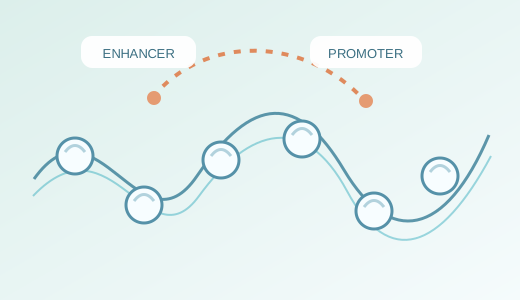
Conceptual illustration of enhancer-promoter communication across chromatin
FIELD 01

Cancer epigenomics

Chromatin regulation, enhancer activity and epigenomic changes affecting cancer cell identity and progression.

Explore focus
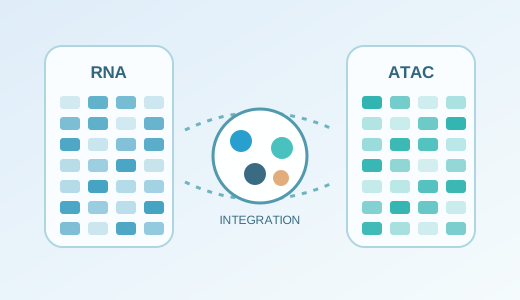
Conceptual RNA and ATAC single-cell integration diagram
FIELD 02

Single-cell multiomics

Integrative analysis of cellular heterogeneity, plasticity and cancer-associated regulatory programs.

Explore focus
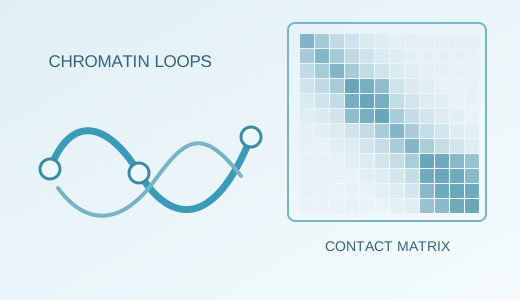
Conceptual chromatin looping and contact matrix, not experimental data
FIELD 03

3D genome architecture

Chromatin interactions, genome organization and the functional architecture of regulatory DNA.

Explore focus
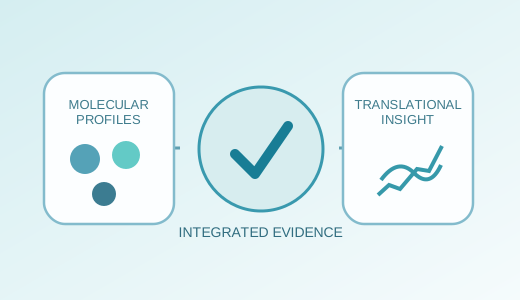
Conceptual molecular profiling to translational insights diagram
FIELD 04

Translational oncology

Patient-derived models, molecular stratification and candidate biomarkers or therapeutic vulnerabilities.

Explore focus
Computational discovery

Machine learning meets genome biology.

We develop and apply statistical, computational and machine-learning approaches—from deep-learning-assisted 3D genome analysis to unsupervised multiomics modelling—to extract biological meaning from high-dimensional datasets.

3D genomicsStatistical learningSingle-cell integration
Explore methods
Selected publications

Recent work.

See all publications
Single-cell epigenomics · 2026

Chromatin accessibility landscapes define stromal cell identities across tissues

Amin Nooranikhojasteh, Ghazaleh Tavallaee, Nicholas Khuu, Shu Yi Shen, Shaida Ouladan, Ayush Raman, Elias Orouji

Communications BiologyRead paper
Computational methods · 2025

Benchmarking peak calling methods for CUT&RUN

Amin Nooranikhojasteh, Ghazaleh Tavallaee, Elias Orouji

BioinformaticsRead paper
Oncology perspective · 2025

Chimeric Antigen Receptor-T Cells in Colorectal Cancer: Pioneering New Avenues in Solid Tumor Immunotherapy

Shaida Ouladan, Elias Orouji

Journal of Clinical OncologyRead paper
Lab highlights

Latest from the lab.

All lab news
FUNDING · SEPTEMBER 2026

New Cancer Research Society grant supports collaborative oncology research

A Cancer Research Society operating grant was approved to investigate DDX55 in prostate cancer. Epigenome Lab is a research collaborator, contributing epigenomic assays and computational analysis expertise.

Read the announcement
PUBLICATION

Single-cell chromatin accessibility atlas published

Our study in Communications Biology profiles 51,248 cells from nine mouse tissues, mapping conserved and tissue-specific regulatory programs.

Read more
PUBLICATION

Benchmarking CUT&RUN peak calling in Bioinformatics

A systematic comparison of MACS2, SEACR, GoPeaks and LanceOtron provides guidance for method selection and reproducible epigenomics analyses.

Read more